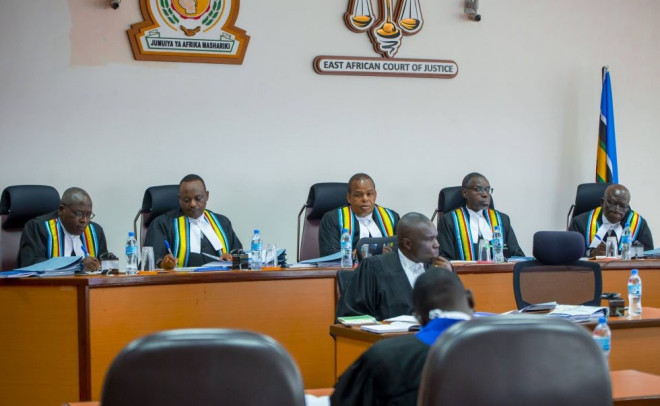
The conflict between the highest institutions of the Somali government has entered a new phase, following the filing of a lawsuit against the Federal Government of Somalia by six judges from the country’s Supreme Court with the East African Court of Justice (EACJ). The judges are challenging the removal of the Chief Justice, Bashe Yusuf Ahmed, as well as other actions they claim have undermined judicial independence.
On November 18, 2026, the East African Court of Justice issued a formal notice granting the Federal Government of Somalia and the Attorney General 45 days to respond to the case. This development signifies that the dispute between the Presidency and the Supreme Court has now escalated to a regional judicial level.
This lawsuit represents a significant legal step, as the judges are seeking a review—by a judicial body within the East African Community—of the actions taken against the leadership of the Supreme Court. The judges argue that these measures have negatively impacted the operations and independence of Somalia’s highest judicial institution. The lawsuit has been filed against the Federal Republic of Somalia and the Attorney General of the Nation. The judges are seeking an examination of the legality of the actions taken against the leadership of the Supreme Court, as well as the impact these actions have had on judicial independence.
A court notice dated November 18 grants the government 45 days to submit its response and legal defense. Should the government fail to respond within this period, the court is empowered to proceed with the case and reach a verdict without a response from the government side.
This case has been registered under Ref. No. 69 of 2026.
The judges’ lawsuit stems from a dispute that intensified on November 4, 2026, when President Hassan Sheikh Mohamud removed the Chief Justice of the Supreme Court, Baashe Yusuf Ahmed, from his position and simultaneously appointed Ibrahim Idle Suleyman to the role.
At the time, the Presidency stated that the decision was prompted by complaints submitted by judges, judicial staff, and members of the legal community, concerning the administration and integrity of judicial operations. However, the dismissal occurred just one day before the Supreme Court was expected to issue a ruling on a case concerning constitutional amendments and the tenure of government institutions.
This development raised legal and political questions regarding the President’s authority to dismiss the Chief Justice—particularly at a time when the Court was presiding over a case involving sensitive political matters.
On November 5, 2026, the Supreme Court issued a ruling declaring the dismissal of Baashe Yusuf Ahmed unlawful, arguing that the President lacks the constitutional authority to unilaterally remove the Chief Justice from office without following established legal procedures.
The Court also issued a ruling on the dispute concerning constitutional amendments and the terms of office for government institutions. In that ruling, it was stated that constitutional amendments could not be applied retroactively to incumbent institutions; it noted that the President’s term ended on May 15, 2026, while the terms of both houses of the Federal Parliament concluded on April 14, 2026.
The Court ordered political stakeholders to agree on an electoral process within 30 days and mandated that elections be held within a period not exceeding 90 days.
This decision further intensified the conflict between government institutions, as the Presidency and other political factions held opposing views regarding the legitimacy of the constitutional amendments and the duration for which government institutions could remain in power.
Although the Supreme Court declared the removal of Baashe Yusuf Ahmed unlawful, President Hassan Sheikh Mohamud proceeded to swear in Ibrahim Idle Suleyman as the new Chief Justice on November 7.
This move further complicated the situation, as the two sides remained at odds over who legally holds leadership of the country’s highest judicial body. The dispute has also impacted the institution’s operations, raising concerns regarding the court’s authority, the independence of its judges, and the preservation of the separation of powers.
The East African Court of Justice, based in Arusha, Tanzania, is a judicial body of the East African Community (EAC); its mandate includes the interpretation and application of the organization’s founding treaty.
Somalia became a full member of the East African Community in 2024, enabling the country to integrate into the regional legal framework and cooperation system of the organization.
Somali judges are currently seeking to have the regional court examine their grievances regarding judicial independence and government actions, while awaiting the federal government’s submission of its legal defense.
However, the 45-day notice does not constitute a court ruling confirming that the government has violated the law; rather, it is a procedural step that provides the government an opportunity to respond to the lawsuit.
The dispute has also drawn the attention of the international community. On November 12, 2026, United Nations experts addressing the state of the judiciary in Somalia expressed concern over the removal of Bashe Yusuf Ahmed from his position, calling for the protection of judicial independence.
These experts also raised concerns regarding the safety of judges, as well as restrictions that have reportedly hindered their freedom of movement.
For its part, Somalia’s Ministry of Justice has responded to these criticisms, defending the government’s position regarding the reforms being implemented within judicial institutions. The 45-day period granted to the government by the East African Court of Justice marks a critical phase in the case, as the government is expected to present the legal justifications for its decisions regarding the leadership of the Supreme Court.
Arguments from both sides are expected to focus on the President’s constitutional powers, the procedures for appointing and removing judicial leaders, and the preservation of the independence of the judiciary.
Furthermore, it remains to be determined to what extent the East African Court of Justice has the jurisdiction to hear complaints concerning actions taken by Somali government institutions—a matter that will depend on the Court’s own statutes and legal mandate.
Bringing this case before the East African Court of Justice elevates the dispute between the Presidency and the Somali judiciary to a new legal level, with the six judges seeking a regional review of the actions taken against the Supreme Court’s leadership.
This development also reignites the debate surrounding judicial independence, the separation of government powers, and which entity holds the ultimate authority to interpret the constitution. The Somali people and the international community are currently watching for the Federal Government’s response and the subsequent steps taken by the regional court, as the outcome of the case could have legal and political implications for Somalia’s system of governance.